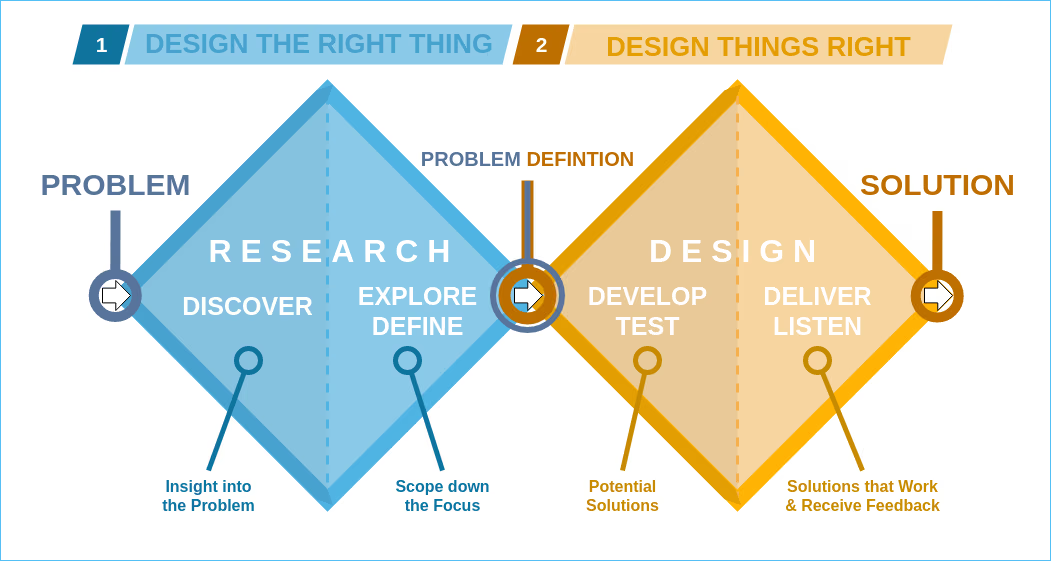
Developed by Design Council UK, Double Diamond is a visual innovation method, clearly structured in four steps: Discover → Define → Develop → Deliver. The first diamond forces you to understand the real problem. The second guides you to deliver the right solution. It's counterintuitive for many: you don't start with the solution, but with the struggle.
Double Diamond Assessment: Strengths and Weaknesses
How does Double Diamond score on stability, innovation, and resilience?
Stability
High, if you have the time
Reframing the problem avoids overfitting on the wrong needs.
Innovation
Good
The process encourages diverse solutions, with real exploration of options. You don't jump straight to execution.
Resistance
Weak under pressure
The method requires resources, patience, and mental space. Under deadlines, teams skip the first diamond and everything reduces to “just deliver something.”
Where Double Diamond Gives In
Rigidity
It's hard to apply in rapid sprints or in startups that want weekly delivery.
Consensus is hard to achieve
The reframing stages require real involvement from multiple actors (UX, client, stakeholders). If one is missing, quality drops drastically.
No cross-context validation guarantee
The method produces good solutions for the current context, but doesn't offer an internal tool for testing in completely different environments.
When Is Double Diamond Worth Using?
Use when
Projects with high ambiguity
When even the problem isn't clear, it's an excellent tool for bringing order.
Products with interfaces and user experience
It helps you understand real needs more deeply. Also works well in public policy.
Avoid when
Doesn't work when time is critical
If you need to deliver something validated in 2 weeks, the method can become a luxury that's hard to sustain.
Conclusion
Double Diamond gives you strategic clarity and empathy, but it's not a rapid-fire tool. In pressured environments, teams skip it. In stable environments, it produces gold.