Planning employee transport in Excel is a common practice, but it has clear limitations. When is the right time to transition to a dedicated digital solution?
Excel – a good solution, but only up to a point
Ideal for small companies
Excel works well in organizations with a relatively small number of employees, where situations are simpler.
Limited geographic area
As long as employees come from nearby areas where routes are predictable, Excel can be efficient.
But as organizations grow, the cracks begin to show. Here’s when and why Excel starts working against you:
Where does Excel stop being a reliable solution?
Growing number of employees
Transport management becomes exponentially more complex as the number of employees increases, even by a small amount.
Diversification of locations
Routes become less clear when employees come from increasingly diverse and distant areas, making route optimization difficult.
Staff volatility
Frequent departures and new hires complicate the updating of transport data, making planning an unreliable and time-consuming process.
Excel's limitations in employee transport management
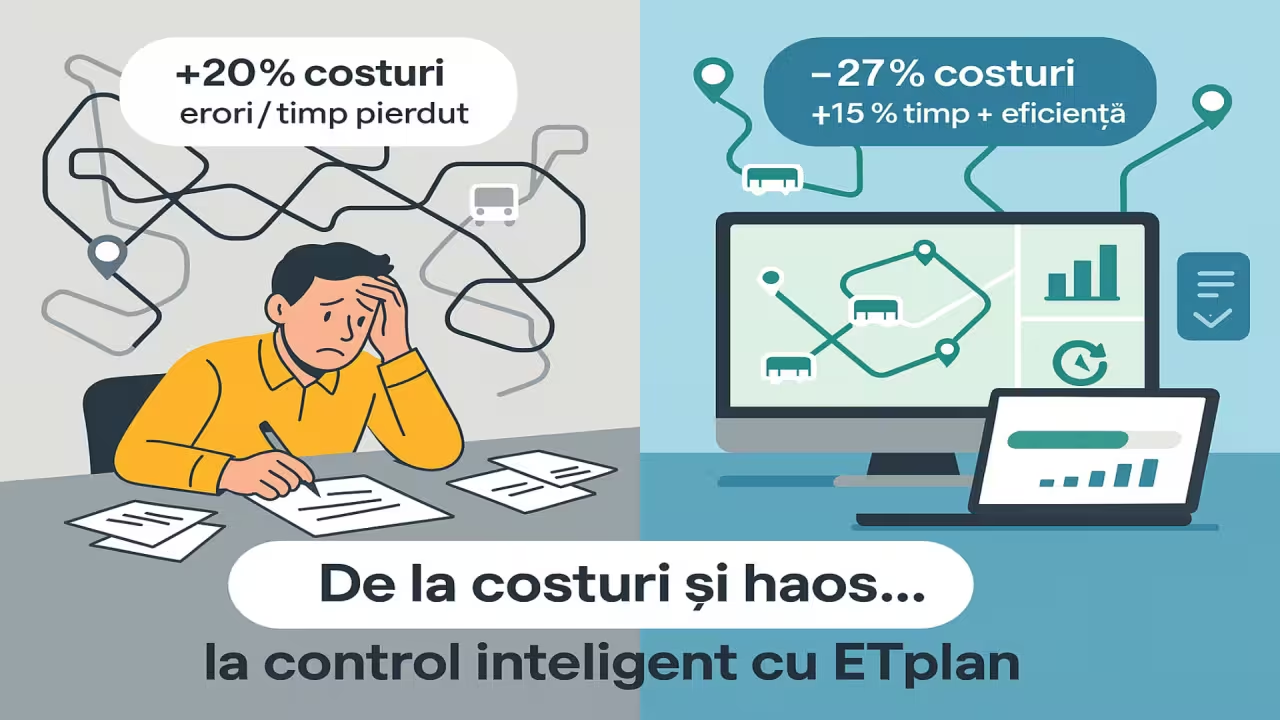
Impossible-to-manage complexity
When the amount of data grows, Excel becomes impractical. Manual routing and data updating become impossible to track correctly.
Lack of cost control
Real costs become hard to estimate and control with Excel data, where there is no centralized view of all cost factors.
Risk of errors
Being dependent on manual input, there is a risk of mistakes when entering or deleting data, and the lack of automatic validation makes data accuracy difficult.
These challenges aren’t a matter of effort — they’re structural. Excel was never designed for dynamic, multi-variable transport planning. The answer is a purpose-built tool.
The solution: dedicated software for employee transport management
Flexibility and automatic updates
Dedicated software enables real-time routing and data updating, without errors and without the time lost on manual modifications.
Cost visibility
Digital solutions provide an overview of costs and the factors involved, facilitating efficient budget control.
Integrated communication
It provides a centralized platform for all stakeholders: managers, HR, employees, and transporters, reducing the risks of miscommunication and creating a smooth, well-organized experience.