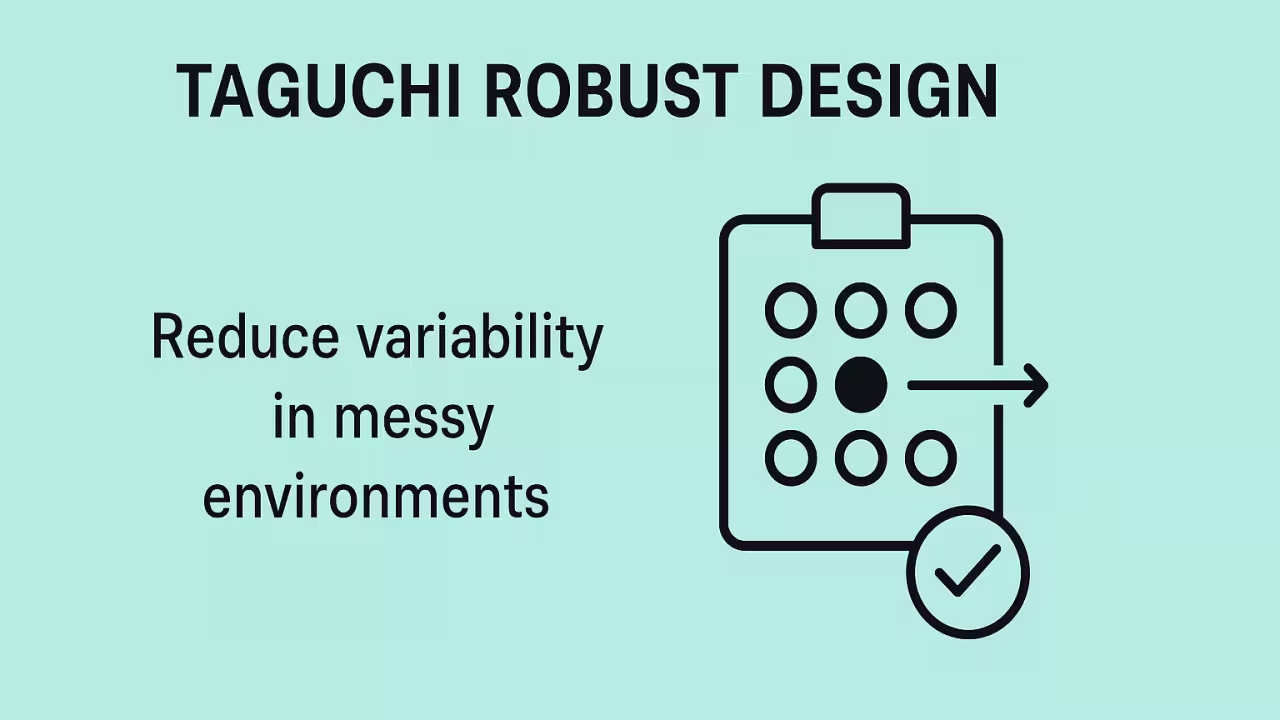
Invented by Genichi Taguchi in post-war Japan, Taguchi Robust Design is a design method that doesn't seek perfection in the lab, but durability in reality. Industry needed products that could withstand uncontrolled variations: temperature differences, imperfect assembly, variable material quality. Taguchi changed the paradigm: instead of optimizing for average, you optimize for consistency.
How Does It Work?
The method uses planned factorial experiments with orthogonal arrays — sets of parameter combinations that cover maximum cases with minimum tests.
Experiments with orthogonal arrays
Instead of testing 100 combinations, you can test 8 and draw the same conclusions. Optimized sets that cover maximum cases with minimum tests.
Signal-to-noise ratio (S/N)
The goal is to check whether the product remains stable in the face of variation (noise). A high S/N ratio means consistent performance.
Practical example
You want an engine design that works at temperatures from -20°C to +60°C. Taguchi helps you find the combination of materials and parameters that offers the least performance variation, regardless of temperature.
Taguchi Assessment: Strengths and Weaknesses
How does Taguchi score on stability, innovation, and resilience?
Stability
Exceptional
It’s built to isolate and control variations that in reality escape control.
Innovation
Moderate
It doesn’t innovate the product itself, but makes it robust.
Resistance
Good in industry
You can apply the same method in automotive, home appliances, and medical instruments.
Where Taguchi Gives In
Limited to physical parameters
It doesn't help when the noise comes from marketing, user experience, or business models.
Can hide important interactions
If the experiment design is too compact (saturated array), some parameter interactions may remain undetected.
Doesn't apply easily to software
If the system is logical, not physical, Taguchi loses its value.
When to Use Taguchi
Use when
Physical product design
Where you have tight tolerances: plastic injection, PCB assembly, mechanical assemblies.
Testing and validation phases
You can drastically reduce testing time and cost through well-designed experiments.
Avoid when
Avoid it for software products
For user experiences or business models with high uncertainty, Taguchi doesn't bring value.
Conclusion
Taguchi doesn't make you an innovator, but it guarantees that the things you innovate don't crack in the real world. It's the S-I-R method's shield on the stability-under-stress component.