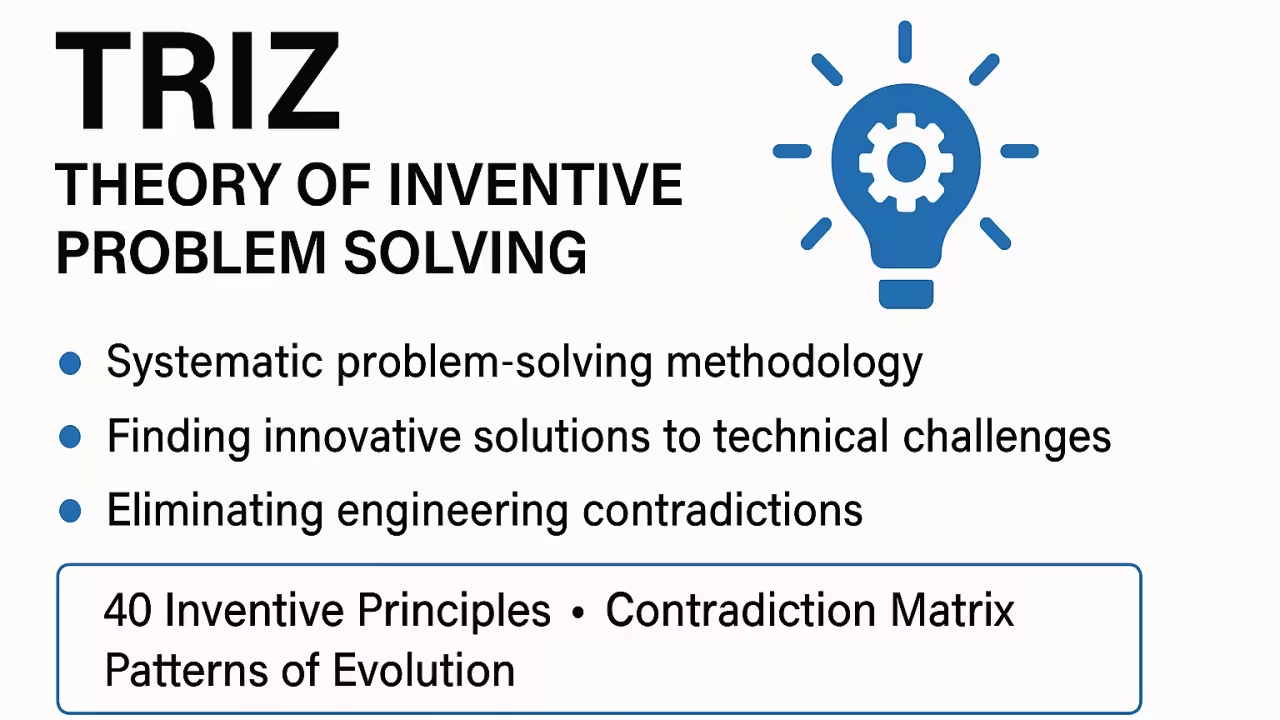
In the 1940s, Genrich Altshuller, a Russian engineer in the Soviet navy, analyzed over 200,000 patents and noticed a pattern: most inventions didn't appear randomly but followed clear rules. This is how TRIZ was born – the "Theory of Inventive Problem Solving" (in Russian: Teoriya Resheniya Izobretatelskikh Zadach).
What is TRIZ?
TRIZ is a systematic methodology for solving technical problems and finding innovative solutions, used in R&D, manufacturing, engineering, and strategy. Unlike brainstorming, which relies on intuition, TRIZ provides a logical framework based on:
40 inventive principles
Principles such as inversion, segmentation, and preliminary action, derived from systematic patent analysis.
39 technical parameters and the contradiction matrix
A tool that identifies technical conflicts and suggests the appropriate inventive principles for resolving them.
Technological evolution models
Concepts of ideality and available resources that guide innovation toward optimal and sustainable solutions.
TRIZ Assessment: Strengths and Weaknesses
How does TRIZ score on stability, innovation, and resilience?
Stability
High
TRIZ forces you to think of robust solutions that work even under unforeseen or extreme conditions.
Innovation
Excellent
It doesn’t do tuning – it forces you to break patterns. It asks: “How can you have both seemingly impossible things?”
Resistance
Partial
The principles are generalizable, but implementation requires hard work and dedicated training.
Where TRIZ Gets Stuck
Hard to learn
Requires a solid technical background and engineering mindset.
No clear decision thresholds
Without KPIs or metrics, it's hard to integrate into modern agile workflows.
Doesn't work well for soft problems
If you have a UX, design thinking, or business model problem, TRIZ doesn't have the right tools.
When to Use TRIZ
Use when
Technical R&D and product engineering
In automotive, electronics, engineering – when you have hard constraints (space, material, energy), TRIZ can deliver out-of-the-box ideas without magic.
Eliminating compromise
Have two opposing requirements? TRIZ is made exactly for that.
Avoid when
Avoid it for rapid MVPs
For projects with unclear scope or where the team isn't technical, TRIZ becomes a brake, not an accelerator.
Conclusion
TRIZ is like an exoskeleton: it makes you powerful, but it slows you down if you don't know exactly what you want to lift.