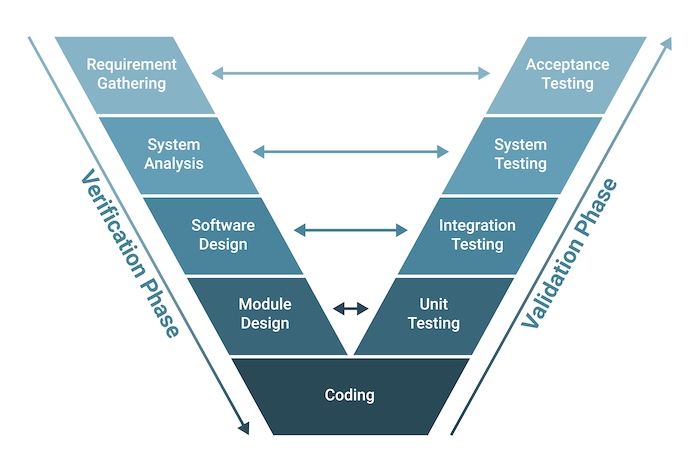
V-Model is a sequential development methodology used especially in engineering, automotive, aerospace, or critical software. It’s named this way because the design and development phases are “mirrored” by testing and validation phases. Top-down you design (requirements → design → code), then bottom-up you verify (unit test → integration → system test). It’s as if every decision is doubled by a test that validates it.
V-Model Assessment: Strengths and Weaknesses
How does V-Model score on stability, innovation, and resilience?
Stability
High
Tests are planned from the start, and each step has a clear checkpoint. Perfect in environments with zero error tolerance.
Innovation
Low
V-Model is defensive, not exploratory. It doesn’t encourage experimentation or rapid architecture changes.
Resistance
Low in dynamic contexts
If the environment changes (requirements, business context), the model becomes hard to adapt – modification costs grow exponentially.
Where V-Model Fails
Procedural Rigidity
Any change in requirements implies complete revalidation. It doesn’t work in agile environments.
Long Cycle
Results come late. You don’t see intermediate value or rapid feedback.
Not Compatible with MVP Thinking
If you want to quickly test a product in the market, V-Model blocks you with documentation and overly long validation phases.
When Is V-Model Worth Using?
Use when
In Critical Systems
Medical software, automotive safety, regulated processes where each step must be verified and documented.
In Developments with Fixed Requirements and Large Teams
The clear structure helps coordinate dozens of people, especially when delivery spans years.
Avoid when
Avoid in Prototypes and Volatile Environments
Not suitable for products with high unknowns or when the business context is volatile.
Conclusion
V-Model is engineering discipline taken to the extreme. It doesn’t make mistakes, but it doesn’t move fast. If you already know everything you need to do and nothing will change, it’s a shield. Otherwise, it’s a cage.