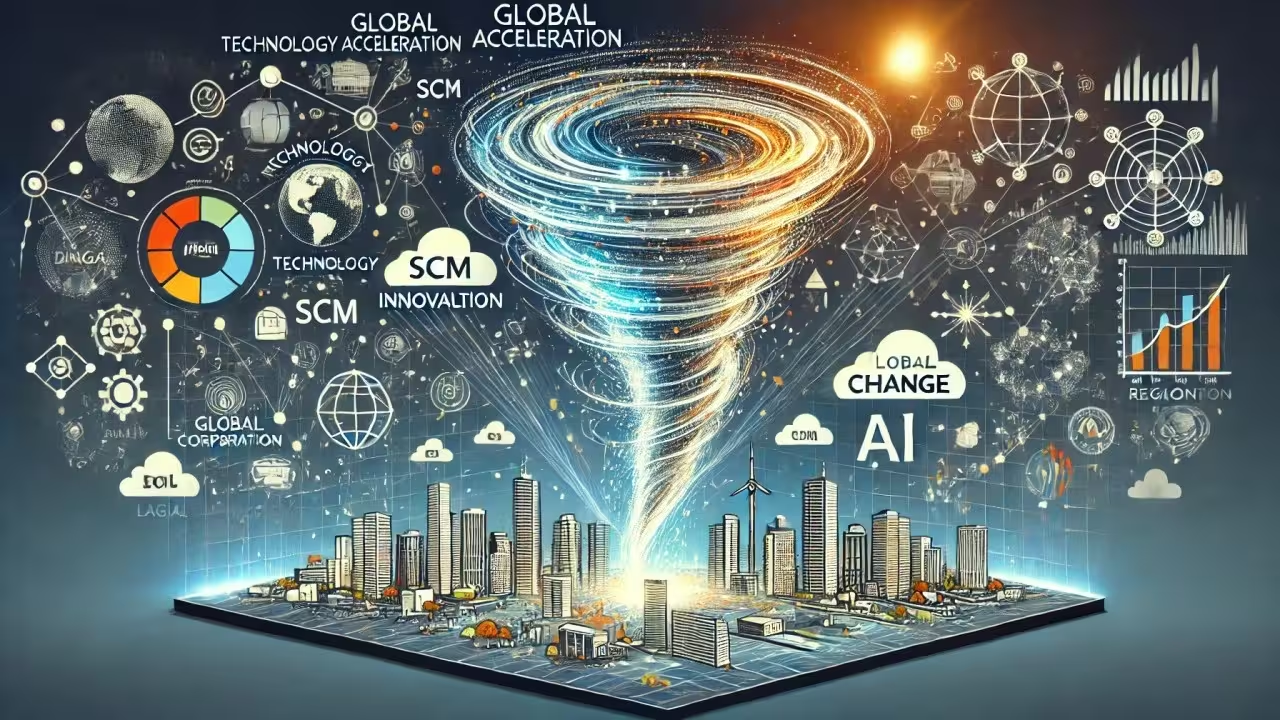
Looking at the global situation from the perspective of continuous change, it is clear that we are in a period of constant acceleration. How can companies navigate this “tornado of change”?
The Tornado of Change
Change or movement, called here “entropy,” can be compared to a tornado: the more energy it receives, the stronger, faster, and harder to control it becomes. This energy is represented by the ever-increasing amount of energy consumed globally, and the graph of global consumption over the last 70 years clearly shows this acceleration.

For companies, this reality means innovation and change so rapid that they become difficult to manage. Each new technology directly contributes to this acceleration, forcing companies to adapt faster and more frequently than before.
Two Strategies in the Market
Following global expansion and the creation of mega-corporations, this “tornado of change” is beginning to put pressure on very large structures, which become too cumbersome to absorb rapid changes. Currently, two distinct strategies can be observed:
Goliath — Centralization and Control
Very large companies try to maintain their global structure and integrity by strengthening and centralizing control.
David — Agility and Decentralization
More agile companies choose to relinquish some central control, adopting a more flexible structure where local or regional subsidiaries have the freedom to adapt quickly and independently, while still maintaining a common strategic direction.
The Transition in Supply Chain Management
Applying this logic to Supply Chain Management (SCM), we see a clear transition from centralized global applications and control toward regional and local management. This means local organizations can have their own standards and software adapted to local specifics.
However, an essential question arises: how do we align data and decisions to maintain a common direction at group level? How can companies continue to benefit from the advantages of a large structure (for example, volume economies) if each subsidiary uses different systems?
The Solution: Artificial Intelligence
The solution lies in the use of artificial intelligence (AI) and a new approach to data management. A central organization can be supported by an AI that communicates with all local subsidiaries, helping them make decisions that converge toward the common objective of the entire group, while maintaining local agility and independence.
Three Perspectives on Decentralization
How does the shift toward decentralized SCM look through the lens of economics, politics, and technology?
Economic
Reduced Operational Costs
Adopting a decentralized model in SCM does not lead to increased costs, but rather to a reduction. Costs are diminished by simplifying the central apparatus and transforming local subsidiaries into independent, agile, and productive units.
Agile and Productive Subsidiaries
Local subsidiaries become independent units capable of responding quickly to local market challenges, without waiting for centralized approvals.
Central Support for Large Projects
Decentralization also involves a risk: local organizations may face difficulties in sustaining large projects. In such situations, the central organization must have the capacity to support or “lend” to local organizations.
Political
Rapid Tax and Regulatory Changes
Rapid tax changes, commercial and military conflicts, new carbon taxation regulations (such as CBAM in the EU), and regional instability directly affect global supplier activity.
Enhanced Local Flexibility
In a decentralized model, political changes are felt simultaneously by all local actors, but with the advantage of enhanced flexibility and rapid response capability.
Alternative Partnerships
Companies should focus on localizing supply chains and developing solid partnerships with alternative distributors, to quickly compensate for the lack of critical components.
Digital
Global Platforms Are Too Rigid
Global software platforms, such as SAP, tend to be too rigid to efficiently support a decentralized model. Companies hesitate to invest in local solutions, often emphasizing cybersecurity and compliance.
The Decentralization Security Advantage
A decentralized approach can actually be more secure: in the case of a cyberattack, if each local unit uses independent systems, the attack will not contaminate the entire organization.
AI as a Strategic Ally
AI allows the central organization to maintain strategic control by interpreting data through indirect queries and providing coherent directions, without requiring full access to local databases.
Conclusion
In a world characterized by rapid and constant change, companies that embrace agility, decentralization, and intelligent technology will have the most to gain. Adaptability becomes a more valuable resource than rigidity, and artificial intelligence is the instrument that can ensure the success of this transition, maintaining clarity of strategic direction without sacrificing local flexibility.
What will the future hold? Will we continue to live in accelerating change, or will its pace slow down, perhaps allowing us to rebuild and reproduce the same global model we have had until now?